
A sustained-input assumption. Actual comfort needs testing.
Movement / Energy research
Treadspark
A little pedal power under your desk.
A twin-pedal concept for deliberate movement, energy storage, and supplementary charging.
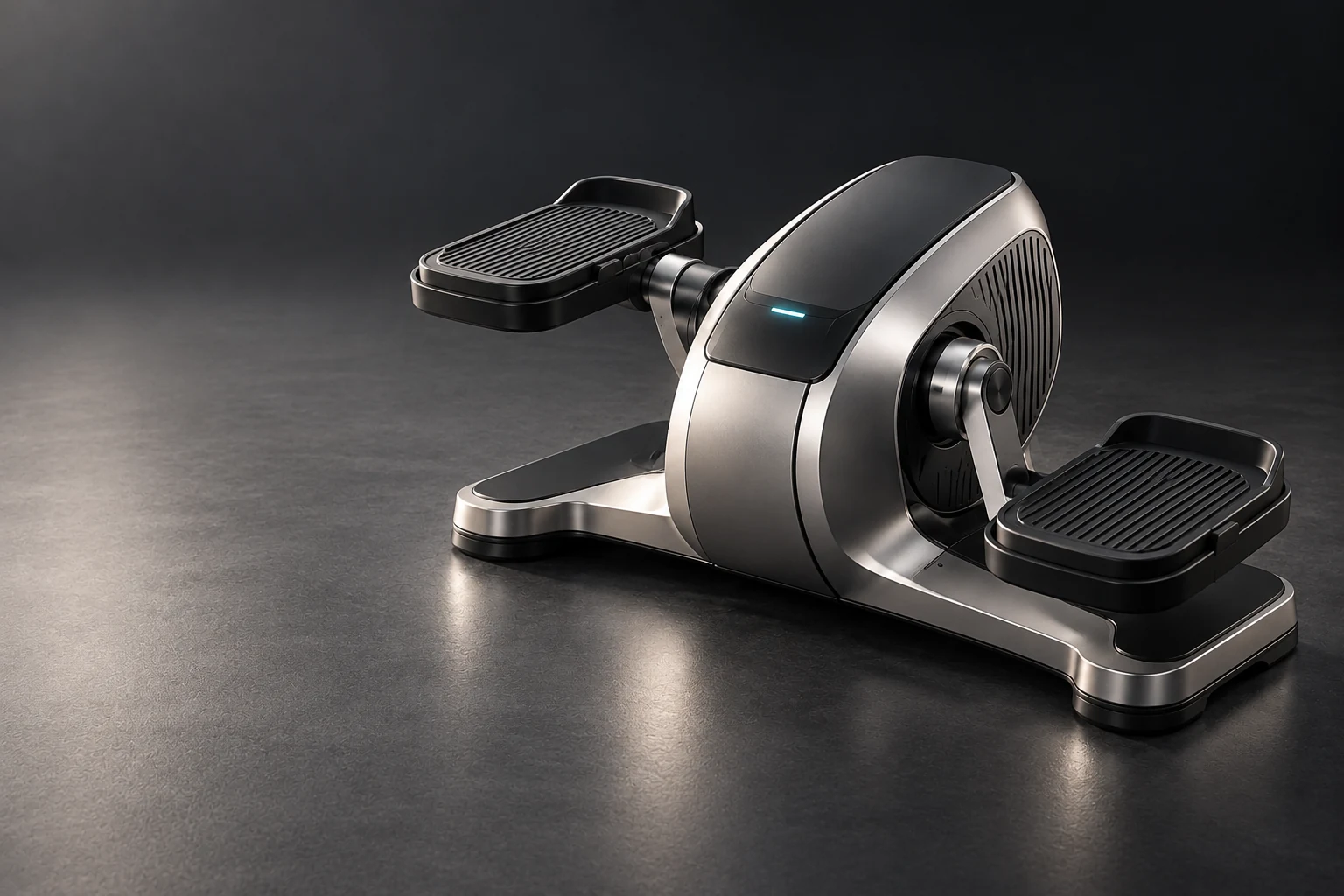
A different use for the space under your desk.
Treadspark explores whether optional pedaling could fit into a workday and contribute useful energy. Comfort, noise, and the energy reaching a device still need to be measured.
- Current stage
- Concept & theoretical research
- Published research
- v1.2 · Oct 22, 2026
- Next step
- Test the mechanism and energy losses
- Take a closer look
- Read the research ↗
THE QUESTION
Could the space under your desk
do one more thing?
Palmform starts with the hand. Treadspark looks a little lower: could movement underfoot become an optional activity and add a little power for your devices?
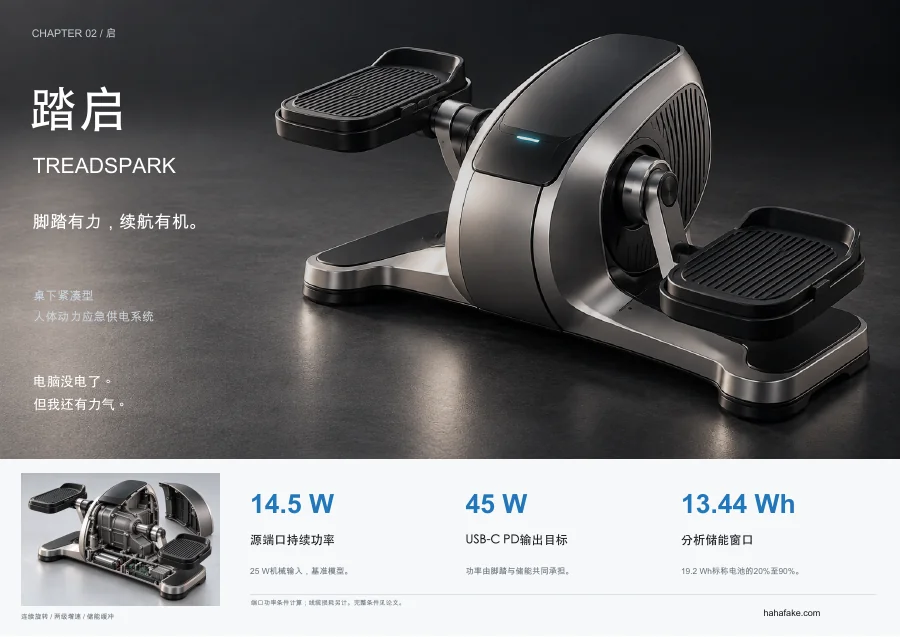
The concept uses one main shaft, two cranks 180° apart and short 85 mm crank arms. Two timing-belt stages raise speed toward the generator. A battery buffer handles pedal input and USB output separately.
The real questions are whether people would want to pedal, whether their knees have enough room, whether noise interrupts work, and how much energy reaches the device after every loss.
TREADSPARK / THE FILM
A little movement underfoot.
A little progress for an idea.
Your computer needs a charge. You could use a little movement.
Turn that movement into an energy question worth exploring.
01:07 / 1080P / English narration & captions
Updated 2026.10.23 · New brand intro and outro · Enable captions in the player
What is the film about?
Starting with low laptop batteries and long hours of sitting, the concept explores pedaling, generation, battery buffering and USB output. The film presents a design concept. Sustained power still depends on the energy model below and future measurements. A 45 W output is a short battery-buffered burst; 25 W of mechanical input cannot continuously produce 45 W.
PUT THE NUMBERS ON THE TABLE
How much power?
Show the working first.
Based on the Treadspark v1.2 model
Mechanical input, source-port output and cable-end delivery measured separately
Includes internal transmission, generation, conversion and auxiliary losses. Cable loss is separate.
25 W continuous input, using the 90%–20% equivalent energy window of a 19.2 Wh battery.
45 W can be a short burst. It is not continuous power from a 25 W input.
Without pedaling, the same battery window supports about 15.41 minutes at 45 W. Under this model, a storage-neutral continuous 45 W output needs about 75.05 W of mechanical input at the crank. Comfort, thermal behavior and device compatibility still need testing.
Show model parameters and measurement boundaries
Efficiencies: transmission 0.90, generation 0.80, rectification 0.92, USB 0.92, charging 0.94 and discharging 0.95. Active auxiliaries use 0.80 W. Assumed battery: 12.8 V × 1.5 Ah = 19.2 Wh. Its 20%–90% window refers to nominal equivalent energy, rather than SOC inferred linearly from terminal voltage.
25 W × 0.90 × 0.80 × 0.92 = 16.56 W at the DC bus. Storage-neutral USB-C source-port output is approximately (16.56 − 0.80) × 0.92 = 14.50 W. With no USB load, 30 minutes theoretically adds 7.41 Wh to storage.
USB efficiency ends at the source port; external cable I²R loss is calculated separately. At 20 V with 0.10 Ω cable-loop resistance, 14.4992 W at the source port delivers about 14.4466 W at the cable end. Assuming 93% laptop conversion efficiency, about 13.4354 W is usable internally. A 45 W source output delivers about 44.4938 W at the cable end.
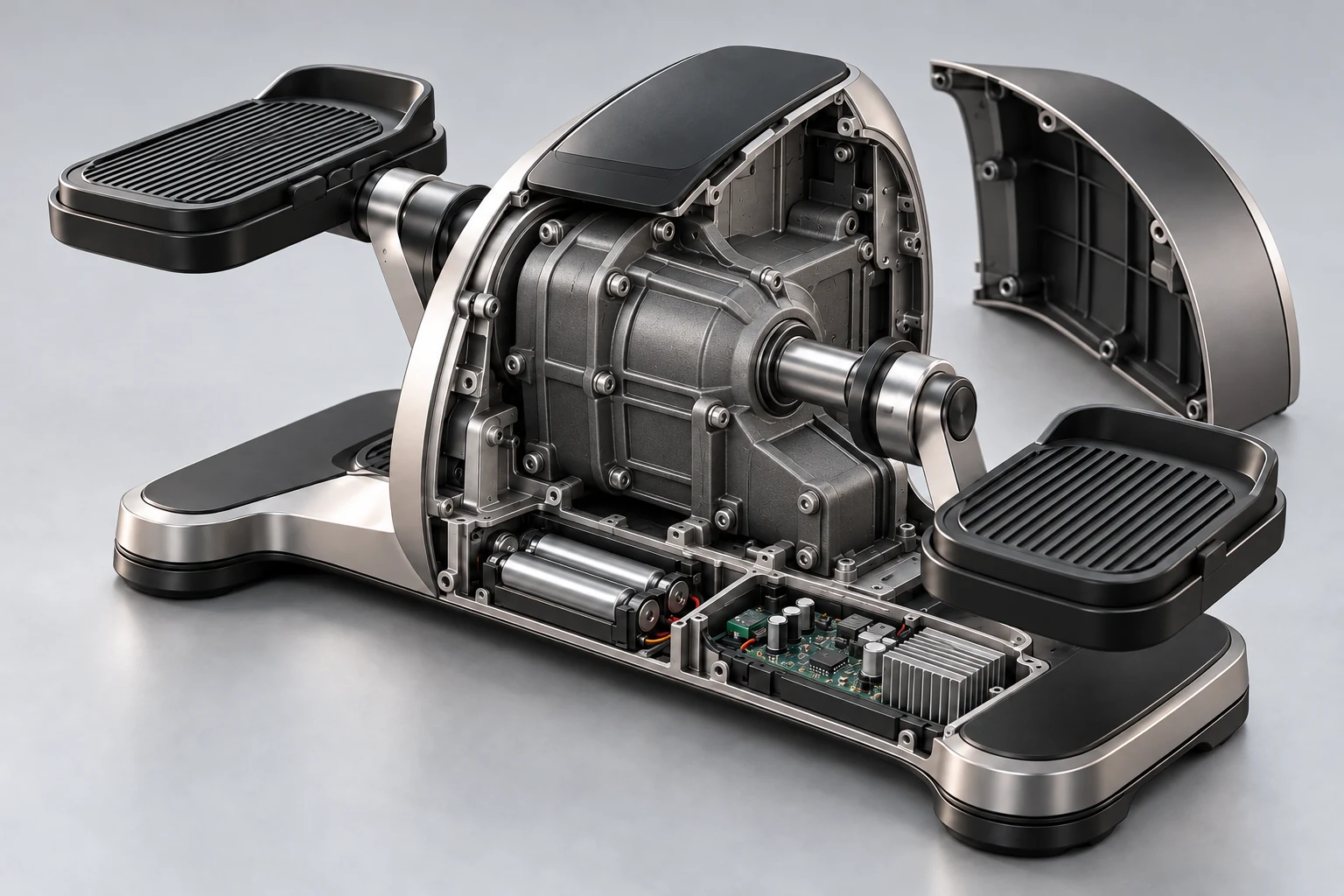 01 / 05
Explore mechanics, battery and output as separate modules.
NEXT, MAKE IT TESTABLE
A rendering is a beginning.
These questions come next.
Check ratios, pulley wrap, bearings, pedal clearance, base grip and tipping resistance. Rendered dimensions are not manufacturing drawings.
Log crank input, DC bus, battery terminals, USB-C source port and cable end together. Vary loads to test losses and protection transitions.
Measure knee clearance, disruption, noise and sustained use with real desks and chairs. Use the results to adjust resistance and form.
THE OPEN RESEARCH / V1.2
Draw the possibility.
Work through the question.
A design book, paper, technical review and product poster.
One version of the research, seen from different angles.
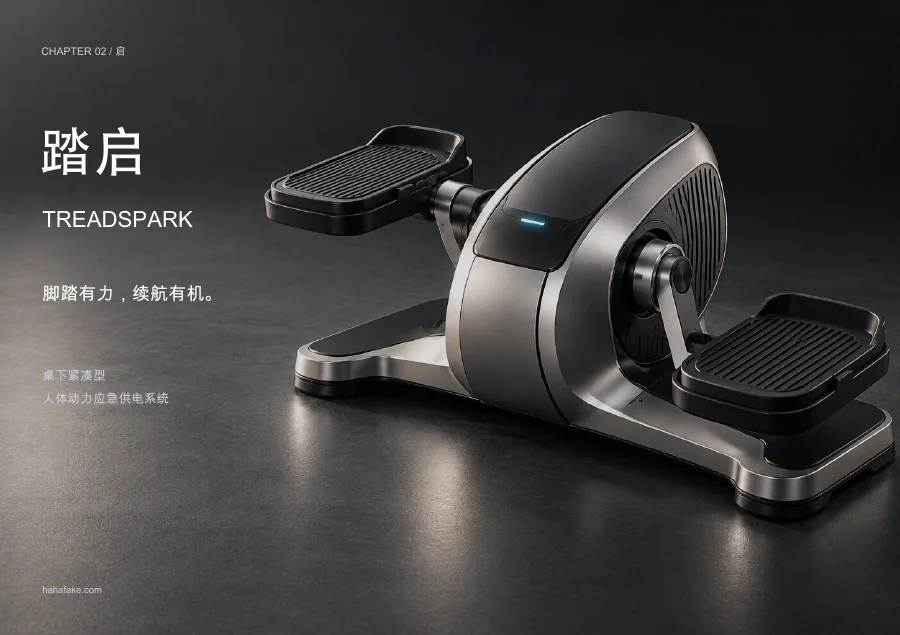 Open to read ↗
Product design book (Chinese)
Form, under-desk settings, transmission modules and material details.
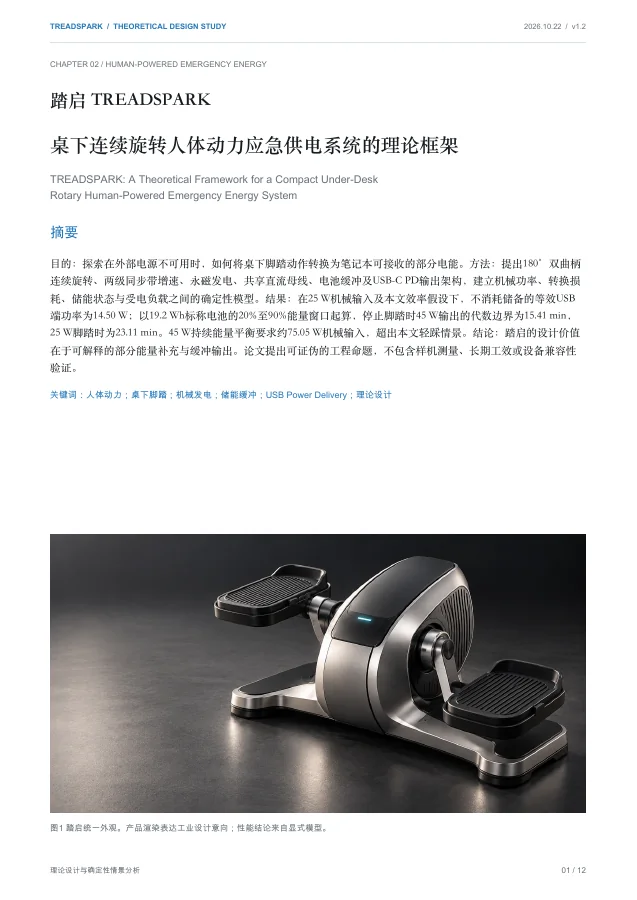 Open to read ↗
Human-powered backup energy paper (Chinese)
The complete input, storage and output model, with calculation boundaries.
 Open to read ↗
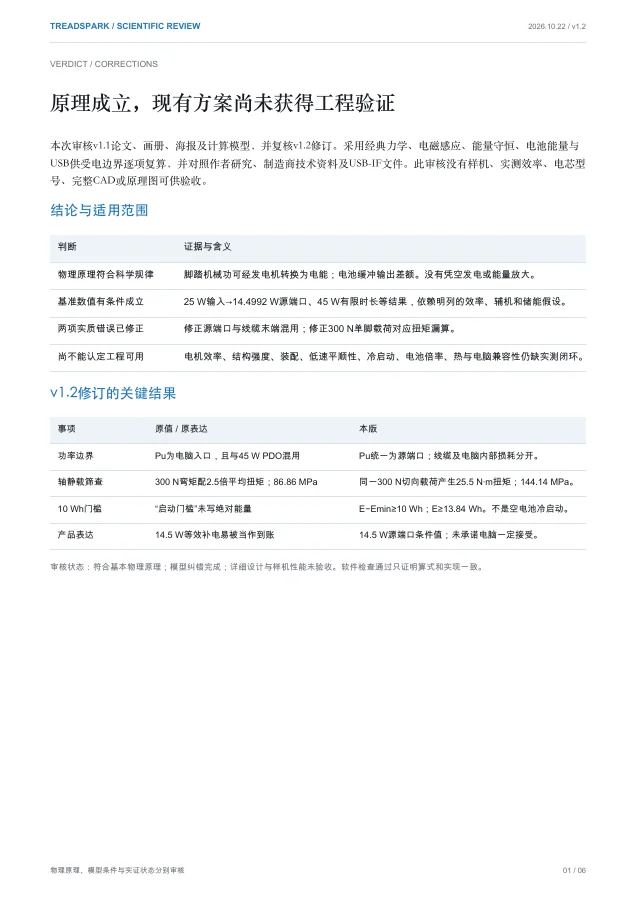
Technical review (Chinese)
Checks power definitions, shaft loads and assumptions awaiting measurement.
 Open to read ↗
CHAPTER 02 · Product poster (Chinese)
One page on Treadspark's design direction and module relationships.
What changed in this revision?
v1.2 separates USB-C source-port output from external cable losses. Shaft bending and torque are calculated under the same foot load, correcting the nominal equivalent stress for a 12 mm shaft to about 144.14 MPa. That value alone cannot establish adequate shaft strength.
“A 10 Wh reserve” means dispatchable energy above the 3.84 Wh minimum threshold, so total stored energy must be at least 13.84 Wh. With 25 W mechanical input and no output load, accumulation theoretically takes about 40.50 minutes. This does not establish that an empty battery system can cold-start.
Research v1.2 · 2026.10.22 · Currently design and theoretical research. Measurement and prototypes come next.
A BETTER QUESTION IS A STEP FORWARD.
Would you pedal it under your desk?
Your desk, a use case or a question the numbers cannot yet answer could take Treadspark a step further.